Posts

Er worden posts getoond met het label gravity field

The gravimeter of professor Vening Meinesz

Afbeelding
On a cold winter day, 21 November 1934, professor Vening Meinesz turned on his pendulum apparatus. Just a few minutes ago, the submarine K-XVIII dived to a depth of 30 meters [1]. A t these depths, t he motion of the surface waves was dampened such that it did not influence the delicate measurements done by the professor. This particular observation would mark the 500th measurement, observing the tiniest changes in the Earth's gravity field. This new gravity dataset would reveal many new mysteries of our home planet and would be the life’s work of Vening Meinesz. It is all documented in scientific publications of four volumes called  Gravity Expeditions at Sea , followed by a fifth volume with gravity observations done by his students. Along these expeditions, the professor had brought his specially designed pendulum apparatus, or folklorised by the sailors on board the many submarines: Het Gouden Kalf  (the Golden Calf). The pendulum apparatus of Vening Meinesz, also kn...

Gravity Expeditions at Sea

Afbeelding
This week one of the major milestones of the Vening Meinesz project is a fact. The website is online, where you can follow the adventure of professor Vening Meinesz onboard the submarine K-XVIII! He sailed from Den Helder, Netherlands to Surabaya, Indonesia via a large detour, visiting ports on several continents. Along the way he measured the gravity field of the Earth with extreme precision. He did this with a pendulum apparatus onboard a moving vessel. A great achievement done by a great scientist. Please explore the website and tell me what you think of it. Enter here ! Oh, for none Dutch speakers, just skip the introduction of the main app, the expedition of Vening Meinesz is written in English. Yet, if you can read Dutch, please check my interview in the TU Delta (University paper) about the project, here  (page 18). The captain and crew of the K-XVIII with the professor among them.

Observing the shape of the Earth

Afbeelding
A few weeks ago, I visited a dear friend of mine at the University of Kiel. He is a professor in geosciences over there. He invited me to meet his team and learn about what they are doing. It was a great week with lot of learning moments. I advise every PhD student and scientist to once in a while visit other groups in your field to see their point of views. Also, it is nice to get out of your office and see the world.  I want to write about one particular learning moment that week, which was a field tutorial with the LaCoste-Romberg gravimeter. This particular device is able to measure relative gravity variations up to 10 microGal. That is a relative variation of 9 digits after the 9.81 m/s^2 (in the Netherlands). This is the domain where you can feel the pull of the Moon, when it is orbiting above you. Wow!!! The Lacoste-Romberg gravimeter in the field.  The LaCoste-Romberg was invented already in 1932 by Lucien LaCoste and his teacher Arnold Romberg, who'd came...

My first estimates of the gravity field of the Rosetta comet, 67P/Churyumov-Gerasimenko

Afbeelding
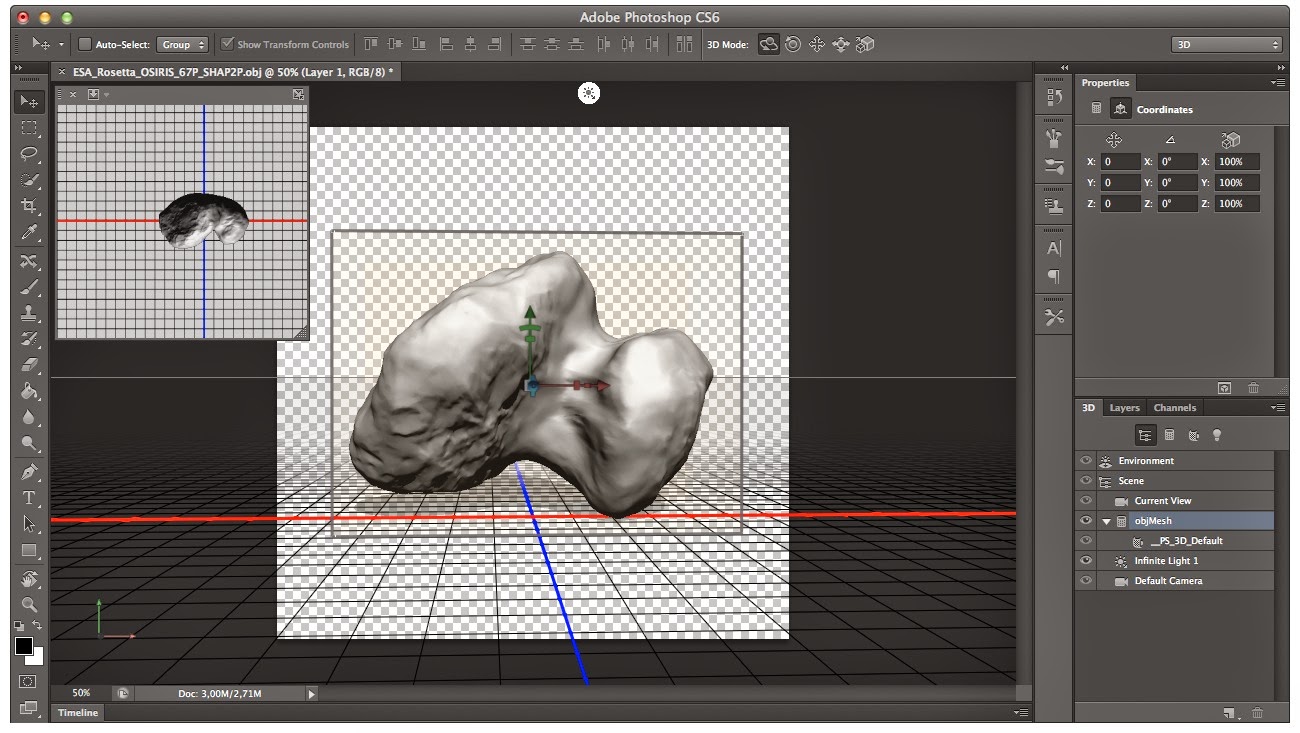
Last week, I saw a very incredible photo compilation. The Rosetta ESA satellite is currently orbiting a comet in outer space. Onboard is a camera, that is constantly taking pictures of the object. On thursday 2 October, the ESA Rosetta blog showed active geysers, shooting water of the comet out into space. What we learned as a kid, we can now see with our own eyes (well via the camera lens, a high-data space downlink, and a remarkable team in the ESA Operations & Science). Active geysers on a COMET !!!!!! Amazing. After re-finding myself from being blown away by amazement, I continued browsing this blog . There, I found that they had build a 3D model of the comet and you (as an internet user) could download it to built your own comet. Totally awesome, unfortunately, I do not have a 3D printer. Nevertheless, I downloaded the files from the blogpost ( see here ). You can download .wrl and .obj files. Clicking on the .obj file, opened the comet in Adobe Photoshop. Look at that, I...

Gravity Expeditions at Sea: Promotion movie

Several blogpost are about this historic project I am working on. We, together with people of the library of the TUDelft, are describing the work and voyages of one of the most adventurous scientist and professor of my university, Professor Vening Meinesz. In the beginning of previous century, professor Vening Meinesz measured Earth's gravity field onboard several submarines of the Dutch Navy. Me, being a geoscientist with experience in gravity field modelling, was asked to explain his work and relate it to Solid Earth Science. Diving into his work and stories, I became very enthusiastic and motivated for the project. We are in the middle of the project and are asking people to help us in any way they can. For this purpose (and because we live in a media-type world), we have made a promotional video. And I wanted to share this first version of the film. Please be aware! You will see me talking science :). If you like the movie and the project, please share it among your friend...

Gravity Art: "The Face of the Earth viewed by a Gravity Scientist"

Afbeelding
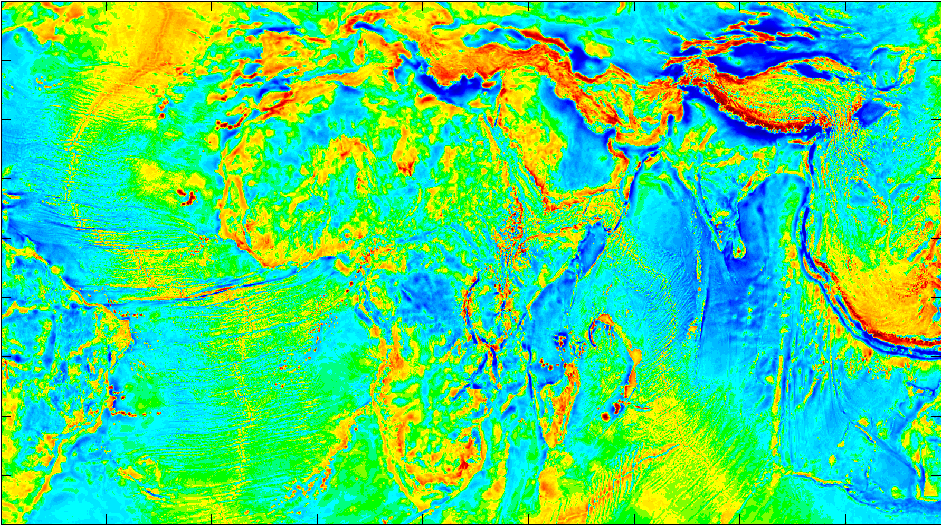
Last week I visited a conference which had the theme: "The Face of the Earth". At the conference were very inspiring talks and interesting scientists. It gave me new inspiration for my blog and my PhD research. It also gave me artistic creativity. So enjoy my art work titled: "The Face of the Earth viewed by a gravity scientist!" (click on figures to enlarge) The figure represents the free air anomaly of the Earth. This anomaly is the deviation of the gravity signal from the main ellipsoidal signal (the 9.81 m/s^2 you learned in high school). The colors represent the magnitude of the deviation. So more mass is red and blue means less mass then the main signal (green is zero). But you don't want to talk numbers, you want to enjoy the colors, because that is art all about. The above picture is of course the old continent Africa. You can clearly see some nice features in the gravity field. In the middle of Africa (Congo) is a large blue area, showing the l...

Gravity shows the shape of Earth (I need your help!)

Afbeelding
I need your help!  A few posts ago , I tried to measure the shape of the Earth using my acceleration chips in my macbook. After a quick sensitivity analyses I found out that the precision of the chips was not sufficient to do this exercise. However, I really want to see if I can measure the curvature of the Earth by looking at its gravity field. So instead of high-tech measurements with my macbook, I want to see if a low-tech solution (a string pendulum) is more accurate. The basic physics behind a pendulum measurement. The relationship between the period (T) of the pendulum and its length (l) and the local gravity (g) is (yes, high school again): Well, this is not entirely correct, but for this experiment (keep the amplitude low!!!) it is good enough (take a look  here  to get a better relationship). So, to measure the local gravity (g) we need to know the length of the pendulum (half-measure!!!) and the period of the pendulum. So, what is my set-up? A p...

Secrets of the deep ocean (a Vening Meinesz story)

Afbeelding
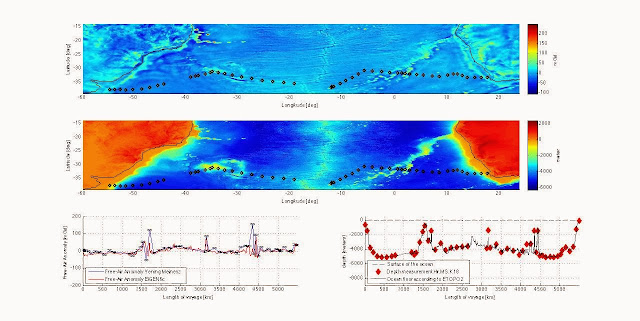
No, this is not a blog about some random Sci-Fi movie, it really is a blog about the secrets of the deep ocean (sorry guys, no shiny sphere that gives you special powers when you touch it). Already as a kid I was fascinated about large structures in the deep depths of our oceans. I will show you some cool geological features and their origin in the deep depths of the South Atlantic Ocean. Fortunately, Vening Meinesz, the geophysicist I am talking about now for some time, sailed over this huge ocean onboard the K18 submarine (yes, yes, I know, again I am spamming you guys about this very interesting and cool scientist).  After visited several ports along the eastern South American coastlines, the K18 and its occupants started from Mar del Plata the difficult crossing of the South Atlantic Ocean. Vening Meinesz wrote in Volume III of his "Gravity Expeditions at Sea", the following about this crossing: The crossing of the Atlantic from Mar del Plata to Cape Town was a s...