Posts

Er worden posts getoond met het label gravity

Determine the shape of the Earth 200 years ago with gravity

Afbeelding
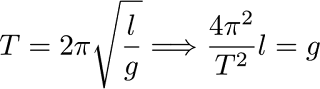
A colleague of mine pointed me to a PhD dissertation of Petrus van Galen. He wrote this dissertation in 1830 and two copies can be found in the Tresor of the TU Delft Library. The title of this dissertation is “ Disputatio Mathematica Inauguralis d e Pendulo Ejusque Applicatione ad Telluris Figuram Determinandam ”. Loosely translated: A Mathematical Essay about the Pendulum and its Application to Determine the Figure of the Earth. Of course, as soon I heard about this, I made an appointment with the librarian responsible for the collection in the Tresor for a viewing session. I also found a  link  in Google books, showing almost the complete dissertation, but I wanted to smell the old pages. Furthermore, the appendices of the dissertation were not scanned properly, so the data, that Petrus van Galen used, were not yet available to me. A week later, I cycled to the Library (appointed as one of the 10 most beautiful libraries of the world and known very well t...

The gravimeter of professor Vening Meinesz

Afbeelding
On a cold winter day, 21 November 1934, professor Vening Meinesz turned on his pendulum apparatus. Just a few minutes ago, the submarine K-XVIII dived to a depth of 30 meters [1]. A t these depths, t he motion of the surface waves was dampened such that it did not influence the delicate measurements done by the professor. This particular observation would mark the 500th measurement, observing the tiniest changes in the Earth's gravity field. This new gravity dataset would reveal many new mysteries of our home planet and would be the life’s work of Vening Meinesz. It is all documented in scientific publications of four volumes called  Gravity Expeditions at Sea , followed by a fifth volume with gravity observations done by his students. Along these expeditions, the professor had brought his specially designed pendulum apparatus, or folklorised by the sailors on board the many submarines: Het Gouden Kalf  (the Golden Calf). The pendulum apparatus of Vening Meinesz, also kn...

Observing gravity on a moving ship

Afbeelding
In the beginning of the 20th century the gravity field of the Earth was only measured on land. Of course, to obtain a complete image of the Earth's gravity field the oceanic area (covering 74% of the Earth) should also be inspected. However, in those days that was a difficult task. Gravity could be measured by several different instruments, but for them to work a stable platform was needed. This is difficult to arrange on a rocking ship. For example, the falling mass principle was used by Simon Stevin (1548-1620), who dropped balls of lead from the New Church in Delft, Netherlands. Later, a dutch sailor and scientist called Christiaan Huygens (1629-1695) found the relation between the period of a pendulum and gravity (I used this relation earlier in the my blog). This is now called the Christiaan's Huygens law. With it the operator was able to measure gravity with a single pendulum, but needed a stable platform, such that horizontal movement did not interfere with the...

Measuring mass changes with satellites

Afbeelding
In my latest paper, GRACE gravity observations constrain Weichselian ice thickness in the Barents Sea , I use an incredible satellite data set. Starting from 2003, NASA's GRACE satellite mission is producing monthly "images" of the Earth's gravity field. These observations are so accurate that certain mass transport is visible, if you look at the differences between these "images". This new data set gives tons of information about many different natural processes. Oh and the figures are so cool! For this blog, I downloaded GRACE data (click here for information, and here for the data) from the period between 2003 and 2013, CSR release. For every spot on the Earth, I calculated the linear gravity change in this period, so not the seasonal variations. The results are shown in the figure below: GRACE gravity change during 2003 and 2013 using a 'white' noise filter of ±0.5 microGal/year. The red areas show localised gravity increase (or ma...

My first estimates of the gravity field of the Rosetta comet, 67P/Churyumov-Gerasimenko

Afbeelding
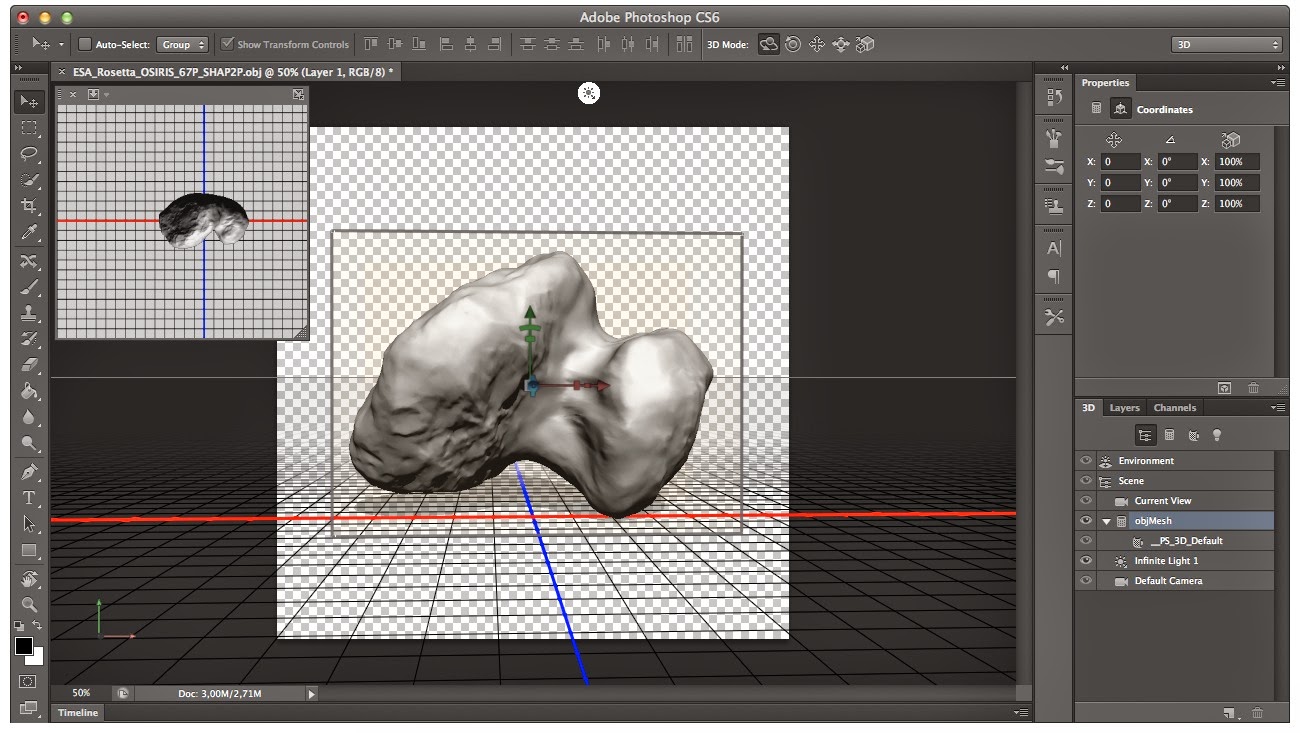
Last week, I saw a very incredible photo compilation. The Rosetta ESA satellite is currently orbiting a comet in outer space. Onboard is a camera, that is constantly taking pictures of the object. On thursday 2 October, the ESA Rosetta blog showed active geysers, shooting water of the comet out into space. What we learned as a kid, we can now see with our own eyes (well via the camera lens, a high-data space downlink, and a remarkable team in the ESA Operations & Science). Active geysers on a COMET !!!!!! Amazing. After re-finding myself from being blown away by amazement, I continued browsing this blog . There, I found that they had build a 3D model of the comet and you (as an internet user) could download it to built your own comet. Totally awesome, unfortunately, I do not have a 3D printer. Nevertheless, I downloaded the files from the blogpost ( see here ). You can download .wrl and .obj files. Clicking on the .obj file, opened the comet in Adobe Photoshop. Look at that, I...

Measuring the geoid. What is the geoid?

Afbeelding
During my weekly fitness session with one of my friends, we started discussing gravity (yes, also my friends are geeks (in the good way)). We discussed the measurements done by Vening Meinesz in the K18. He used I pendulum device, that directly measures the downward gravity attraction in the location of the device, plus all the motions of the device itself. On land, these motion are negligible, but on sea the device swings a lot due the ocean waves. Therefore, Vening Meinesz used a submarine to reduce the motions of the measurement device (waves are dampened underwater). Furthermore, he used three pendulums instead of one, which he ingeniously used to separate the motions of the device and the gravity attraction. Explaining this all to my friend, he remarked that it sounded very complicated and asked me if this could be done more easy. "Yes, this is possible", I replied, "with a GPS receiver". "How is it possible to measure Earth's gravity field with a GPS...