Posts

Er worden posts getoond met het label Vening Meinesz

Determine the shape of the Earth 200 years ago with gravity

Afbeelding
A colleague of mine pointed me to a PhD dissertation of Petrus van Galen. He wrote this dissertation in 1830 and two copies can be found in the Tresor of the TU Delft Library. The title of this dissertation is “ Disputatio Mathematica Inauguralis d e Pendulo Ejusque Applicatione ad Telluris Figuram Determinandam ”. Loosely translated: A Mathematical Essay about the Pendulum and its Application to Determine the Figure of the Earth. Of course, as soon I heard about this, I made an appointment with the librarian responsible for the collection in the Tresor for a viewing session. I also found a  link  in Google books, showing almost the complete dissertation, but I wanted to smell the old pages. Furthermore, the appendices of the dissertation were not scanned properly, so the data, that Petrus van Galen used, were not yet available to me. A week later, I cycled to the Library (appointed as one of the 10 most beautiful libraries of the world and known very well t...

The gravimeter of professor Vening Meinesz

Afbeelding
On a cold winter day, 21 November 1934, professor Vening Meinesz turned on his pendulum apparatus. Just a few minutes ago, the submarine K-XVIII dived to a depth of 30 meters [1]. A t these depths, t he motion of the surface waves was dampened such that it did not influence the delicate measurements done by the professor. This particular observation would mark the 500th measurement, observing the tiniest changes in the Earth's gravity field. This new gravity dataset would reveal many new mysteries of our home planet and would be the life’s work of Vening Meinesz. It is all documented in scientific publications of four volumes called  Gravity Expeditions at Sea , followed by a fifth volume with gravity observations done by his students. Along these expeditions, the professor had brought his specially designed pendulum apparatus, or folklorised by the sailors on board the many submarines: Het Gouden Kalf  (the Golden Calf). The pendulum apparatus of Vening Meinesz, also kn...

Observing gravity on a moving ship

Afbeelding
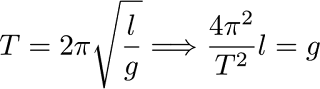
In the beginning of the 20th century the gravity field of the Earth was only measured on land. Of course, to obtain a complete image of the Earth's gravity field the oceanic area (covering 74% of the Earth) should also be inspected. However, in those days that was a difficult task. Gravity could be measured by several different instruments, but for them to work a stable platform was needed. This is difficult to arrange on a rocking ship. For example, the falling mass principle was used by Simon Stevin (1548-1620), who dropped balls of lead from the New Church in Delft, Netherlands. Later, a dutch sailor and scientist called Christiaan Huygens (1629-1695) found the relation between the period of a pendulum and gravity (I used this relation earlier in the my blog). This is now called the Christiaan's Huygens law. With it the operator was able to measure gravity with a single pendulum, but needed a stable platform, such that horizontal movement did not interfere with the...

Gravity Expeditions at Sea

Afbeelding
This week one of the major milestones of the Vening Meinesz project is a fact. The website is online, where you can follow the adventure of professor Vening Meinesz onboard the submarine K-XVIII! He sailed from Den Helder, Netherlands to Surabaya, Indonesia via a large detour, visiting ports on several continents. Along the way he measured the gravity field of the Earth with extreme precision. He did this with a pendulum apparatus onboard a moving vessel. A great achievement done by a great scientist. Please explore the website and tell me what you think of it. Enter here ! Oh, for none Dutch speakers, just skip the introduction of the main app, the expedition of Vening Meinesz is written in English. Yet, if you can read Dutch, please check my interview in the TU Delta (University paper) about the project, here  (page 18). The captain and crew of the K-XVIII with the professor among them.

Gravity Expeditions at Sea: Promotion movie

Several blogpost are about this historic project I am working on. We, together with people of the library of the TUDelft, are describing the work and voyages of one of the most adventurous scientist and professor of my university, Professor Vening Meinesz. In the beginning of previous century, professor Vening Meinesz measured Earth's gravity field onboard several submarines of the Dutch Navy. Me, being a geoscientist with experience in gravity field modelling, was asked to explain his work and relate it to Solid Earth Science. Diving into his work and stories, I became very enthusiastic and motivated for the project. We are in the middle of the project and are asking people to help us in any way they can. For this purpose (and because we live in a media-type world), we have made a promotional video. And I wanted to share this first version of the film. Please be aware! You will see me talking science :). If you like the movie and the project, please share it among your friend...

Secrets of the deep ocean (a Vening Meinesz story)

Afbeelding
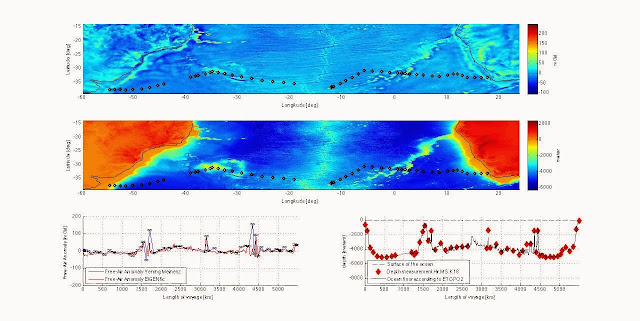
No, this is not a blog about some random Sci-Fi movie, it really is a blog about the secrets of the deep ocean (sorry guys, no shiny sphere that gives you special powers when you touch it). Already as a kid I was fascinated about large structures in the deep depths of our oceans. I will show you some cool geological features and their origin in the deep depths of the South Atlantic Ocean. Fortunately, Vening Meinesz, the geophysicist I am talking about now for some time, sailed over this huge ocean onboard the K18 submarine (yes, yes, I know, again I am spamming you guys about this very interesting and cool scientist).  After visited several ports along the eastern South American coastlines, the K18 and its occupants started from Mar del Plata the difficult crossing of the South Atlantic Ocean. Vening Meinesz wrote in Volume III of his "Gravity Expeditions at Sea", the following about this crossing: The crossing of the Atlantic from Mar del Plata to Cape Town was a s...

Regional Isostasy: supporting a volcano

Afbeelding
Since my participation in the Vening Meinesz project (Read about it in some of my earlier posts), I am reading a lot about this interesting person and his scientific findings. One of his greatest achievements to science is the theory of "Vening Meinesz isostasy" or "regional isostasy". This is a model that I use in my research and it is quite powerful but greatly overlooked. Therefore I thought it would be a good thing to write about here on my blog. The word isostasy, I would think, is not something you would use in a normal conversation. However, you are reading the blog of a scientific geek (Aren't all geeks scientific, hmmmm), so now you will. It all started with a man taking a bath. This man was given the assignment to solve a problem for his king. The assignment was to find out if the new crown of the king was made of pure gold. The king suspected the goldsmith of using silver. Archimedes (the man) was asked to do this without melting it. A diffic...