Posts

Er worden posts getoond met het label submarine

The gravimeter of professor Vening Meinesz

Afbeelding
On a cold winter day, 21 November 1934, professor Vening Meinesz turned on his pendulum apparatus. Just a few minutes ago, the submarine K-XVIII dived to a depth of 30 meters [1]. A t these depths, t he motion of the surface waves was dampened such that it did not influence the delicate measurements done by the professor. This particular observation would mark the 500th measurement, observing the tiniest changes in the Earth's gravity field. This new gravity dataset would reveal many new mysteries of our home planet and would be the life’s work of Vening Meinesz. It is all documented in scientific publications of four volumes called  Gravity Expeditions at Sea , followed by a fifth volume with gravity observations done by his students. Along these expeditions, the professor had brought his specially designed pendulum apparatus, or folklorised by the sailors on board the many submarines: Het Gouden Kalf  (the Golden Calf). The pendulum apparatus of Vening Meinesz, also kn...
Gravity Expeditions at Sea: Promotion movie

Several blogpost are about this historic project I am working on. We, together with people of the library of the TUDelft, are describing the work and voyages of one of the most adventurous scientist and professor of my university, Professor Vening Meinesz. In the beginning of previous century, professor Vening Meinesz measured Earth's gravity field onboard several submarines of the Dutch Navy. Me, being a geoscientist with experience in gravity field modelling, was asked to explain his work and relate it to Solid Earth Science. Diving into his work and stories, I became very enthusiastic and motivated for the project. We are in the middle of the project and are asking people to help us in any way they can. For this purpose (and because we live in a media-type world), we have made a promotional video. And I wanted to share this first version of the film. Please be aware! You will see me talking science :). If you like the movie and the project, please share it among your friend...

Onboard a submarine

Afbeelding
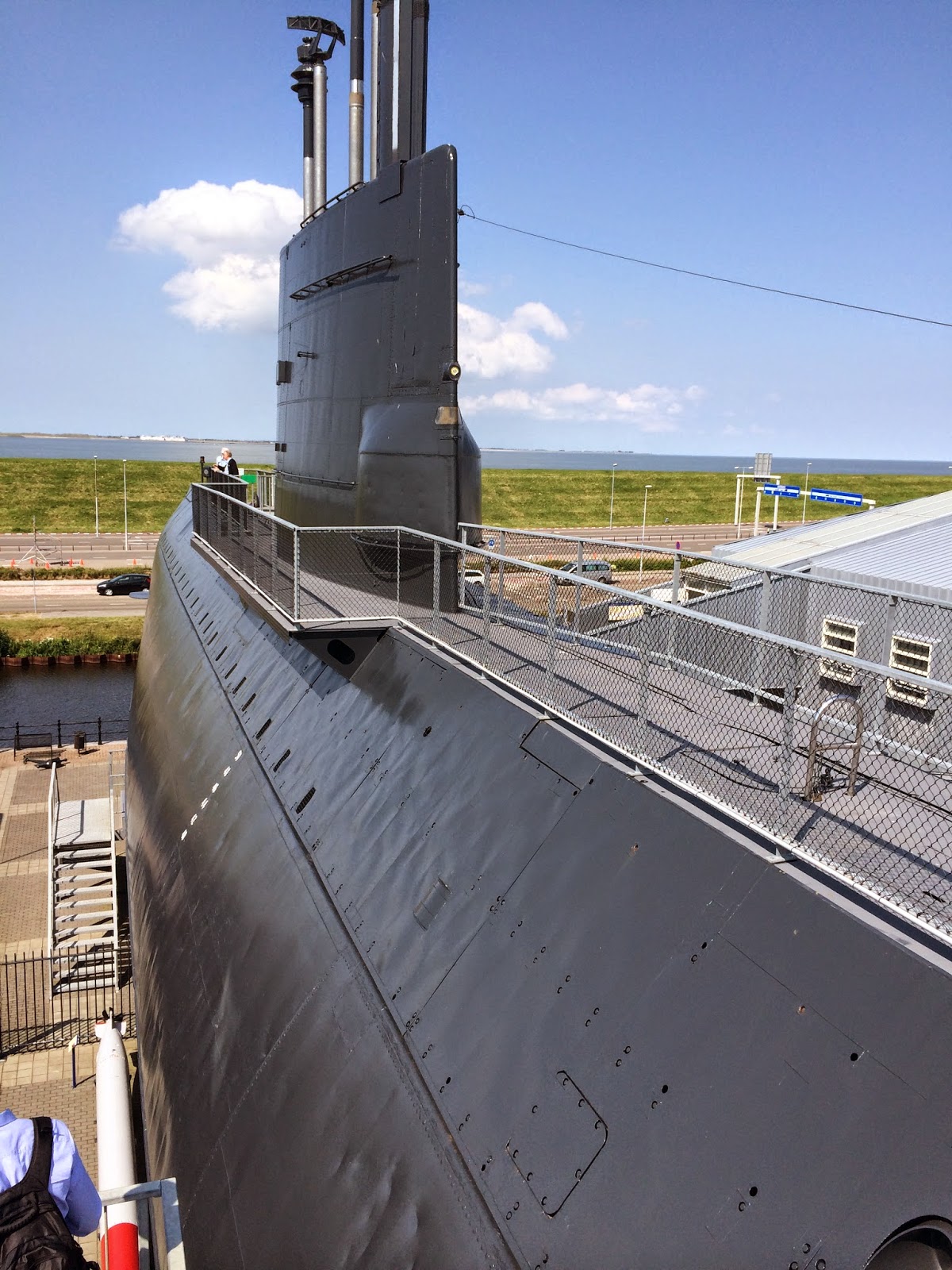
Last week, I could cross something from my bucket list. As the title already hints at, I was onboard a submarine. Ok, the submarine was not submersed in the ocean, it wasn't even in the water, but it was a real submarine, the Hr. Ms. Tonijn ("Tuna"). You can visit this submarine in Den Helder at the museum of the Dutch Navy. However, our project group (Vening Meinesz, I wrote about this) and I were guided by one of the officers that had served on board the Hr. Ms. Tonijn, who gave us an incredible tour inside the submarine. The Hr. Ms. Tonijn was in service between 1966 and 1991 for the Dutch Navy, so it is a more modern version than the Hr. Ms. K18, but some technical details, as we will see, are almost similar. This three cylinder submarine was designed by ir. M. F. Gunning with the top cylinder, being the living quarters and visitable in the museum. The bottom two cylinders contained the massive diesel and electric motors, as well as the chemical battery compartme...

Do it yourself physics: Determining the curvature of the Earth, if you have better equipment

Afbeelding
Working on this new project, see previous post, made me enthusiastic to do some gravity experimentation myself. I wanted to see if I can measure the curvature of the gravity field of Earth myself. I only needed a gravimeter (fancy word for very precise accelerometer). Me, being a 'not-paid-much-just-enough' PhD researcher, I can not buy a very precise gravimeter, but I do have a laptop which contains three accelerometers to protect my harddisk in case of a joint meeting of the laptop and the ground. I wanted to see if I could use these for my little experiment (instead of going on an 8 month dedicated submarine voyage with state-of-the-art instruments, hmmmm, what was I thinking). My laptop is a Macbook Pro (ok, don't start the discussion about which operating system is better. In the end it is all about the person using it) and I found the following code to (pretty easy) access the accelerometer data. The website for reading the accelerometer data gives a nice an...