Posts

Er worden posts getoond met het label Satellite tracking

End of Life of the Nayif-1

Afbeelding
At DopTrack, we listen to the radio transmission of many cube-sats. One in particular, The Nayif-1 (NORADID: 42017) had captured our attention. The onboard radio was claimed to be very stable and its transmission frequency could be used for tracking purposes. So, we decided to track that satellite and recorded its transmission every time it flew over Delft, since 2019. The transmission seems to be very consistent and strong and it gave use a great dataset to assess the quality of DopTrack. Recorded transmission frequency of the Nayif-1 satellite using the DopTrack station. The onboard frequency of the satellite showed a small linear drift over the years. In the 3.5 years we tracked it, the transmission frequency increased 40 Hz. Furthermore it showed some seasonal change and morning and evening passes showed slightly different transmission frequencies, but the stability was much better compared to other cube-sats we tracked.   After the summer holiday, we noticed that the signal wa...
My education experiment: deconstructing Satellite Laser Ranging (part 1)

Afbeelding
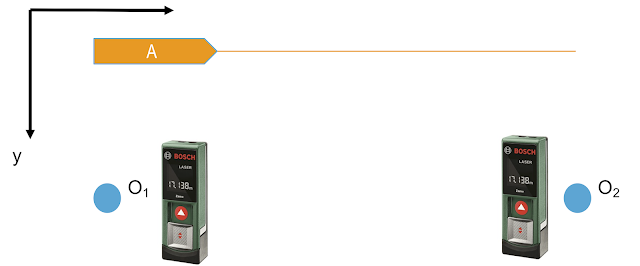
Imagine a spacecraft the size of your car travelling at an altitude of 600 km with a velocity of 7.6 km/s. Now try to determine where the spacecraft is and how fast it is flying, also called its dynamic state. There is no speedometer (no wheels turning) or a pitot tube like in an aircraft (no air to measure). So, we, as astrodynamicists (yes, I think that is a word), have different techniques to accurately determine the state of the spacecraft. Highly accurate measurements of distances (also called range) between the satellite and ground stations are used, as well as the changes in these distances (called range-rate). If you follow this blog a little bit, you know that we work on building a ground station at the TU Delft that measures these range-rates with respect to cubesats. With some complicated, but very elegant mathematics, these measurements are transformed into very precise orbit determinations of satellites. Some of my colleagues can tell you within one cm accurate where thei...

Delfi-C3 is feeling the power of Spring

Afbeelding
All the trees have blossom, baby ducklings are rooming the ponds, and we get more Sun: we survived the winter! Spring is here to give us our much needed vitamine D.  Spring on the campus of TU Delft Not only on the surface of the Earth this is felt, but also in outer space. The Delfi-C3, now more than 9 years orbiting our Earth, notices that spring has arrived on the Northern Hemisphere. During winter, our ground station (DopTrack) only receives data during the morning and mid day (between 8:00 and 13:00 CET). Starting from April, we start receiving signal around 20:00 CET. Fraction of a 24 hour day (UTC) at Time of Closest Approach (TCA) of the Delfi-C3 with DopTrack. We saw this already last year, when in April the telemetry of Delfi-C3 started appearing in the evening. The Sun was already set on the ground, but at 560 km height light was still shinning on the solar cells of the satellite. The satellite is designed such that when sunlight hits the solar cells and eno...

Hearing the sound of a satellite

Afbeelding
So, the last few weeks were quite exciting at the DopTrack satellite tracking station. We have updated the software, such that the station is now able to automatically record any satellite we tell it to record. Also, the radio antennas are installed higher in the sky for better visibility. Moreover, TUDelft students have designed software to automatically extract the carrier signal from raw recordings. And last but not least, the development of the website for the Virtual Laboratory DopTrack is started, but I will report on that later on, when we have a working website. All major steps to have our project become a real educational tool for satellite tracking.  Software update: Automated satellite tracking The DopTrack station is now able to automatically compute, when a satellite is flying over and start recording it accordingly. We just have to set a line of code in the rec.list file and DopTrack is doing the rest. An example recording list is: Delfi-C3     ...

Work of a student: starting his own blog!

Afbeelding
The DopTrack satellite tracking station is in full operation these last weeks. In the Space Minor at the university during my module "Satellite Operations", students are visiting the station and record satellite signals, especially Delfi-C3 and the ISS are very popular. The students then need to determine the Time of Closest Approach (TCA) and the corresponding frequency (FCA). This requires some FFT, but I am confident that they will manage. Furthermore, our intern student has done work on the ground station. His job is to estimate the precision of the Doppler measurements of DopTrack. The last few weeks he has been working at the theory behind the Doppler measurement and some of its characteristics. So with the motto "More scientists and engineers should blog", I asked him to write a blog post about his finding. His results give a clear description about the Doppler measurement. Please follow the next link for his work: http://msondergaard.blogspot.nl/201...

How to make a spectrogram or waterfall plot

Afbeelding
In a few blogpost ago, I showed you several figures of a satellites transmission. You know, those beautiful S-curve plots with all the colours.  Those are called spectrograms or we like to call them waterfall plots, because the radio transmissions streams up in time like a reversed waterfall. To see such a waterfall plot live in action, the University of Twente opened their antennas for you to listen and see (see link ). Yet, how to make such a figure? To start with you need a recorded radio transmission. When the website of the TUDelft tracking station is up and running you can download some data there. However, (Start NerdAlert!) you can also buy your own little USB stick that acts like a software defined radio (SDR) receiver like the Logilink DVB-T . For only 20 euros you have your own satellite tracking station. NOTE: Beware! You need the RTL2832U chip version, because a lot of open software is written for that device. It is almost plug and play, you need some software, b...